

Cotswolds Culture
The Cotswolds Area of Outstanding Natural Beauty spans 787 square miles and is celebrated for its honey-coloured limestone villages, winding lanes, English gardens, cosy pubs and gently rolling hills edged with dry-stone walls and ancient woodland. Its name comes from Old English: “cot” for sheep fold and “wold” for open upland, a fitting reflection of a landscape shaped for centuries by sheep-grazing and wool production.
From the Middle Ages to the 17th century, the Cotswold wool trade—famed for the high-quality “Cotswold Lion” fleece—brought great prosperity, funding impressive churches, manor houses and thriving market towns. While the Northern Cotswolds attract most visitors, the Southern Cotswolds offer the same historic charm and scenery but with a quieter, more relaxed atmosphere and far from the madding crowds!
You can explore our favourite Southern Cotswold circular walks here. Below, we’ve highlighted some of the region’s most characterful towns and villages—places that remain off the main Cotswold tourist treadmill and are all within easy driving distance of Pond Cottage.
Towns and Villages
Wotton-Under-Edge (7 miles)
Wotton-under-Edge sits amid farmland and woodland near the edge of the Cotswold escarpment. First recorded in 940 AD as Wudetun (“enclosure by the wood”), the town was rebuilt after a devastating 13th-century fire and granted market rights in 1252. The Berkeley family played a major role in its development, and in 1384 Lady Katherine Berkeley founded the town’s grammar school—now one of the oldest surviving state schools in the country.
Read More
Prosperity from the medieval wool trade left a legacy of historic buildings, including St Mary the Virgin Church, consecrated in 1283. One of Wotton’s most famous landmarks is the Ancient Ram Inn, a medieval structure dating from 1145 and reputed to be one of England’s most haunted buildings, now open for ghost hunts and overnight stays. Other notable features include the Grade II-listed Town Hall (1700), Tudor-era houses and several historic almshouses.
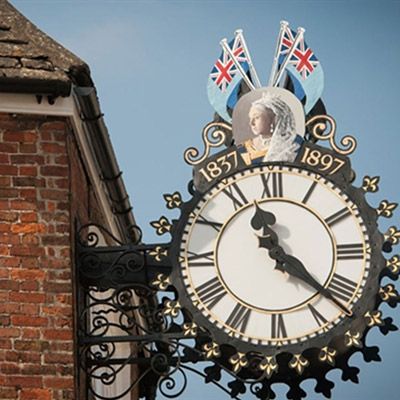
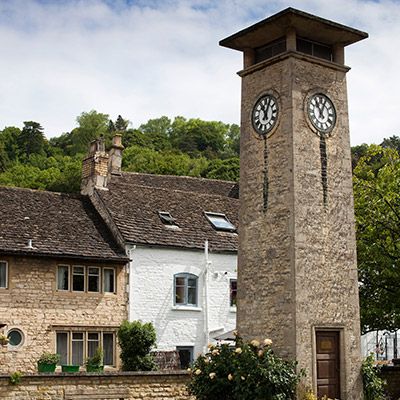
From the later period, the Tolsey Clock—added in 1897 to mark Queen Victoria’s Diamond Jubilee—remains a distinctive sight on the High Street, its gilded details restored in 2015. Back in Old Town, near the church, stands the town’s stone column War Memorial, dedicated in 1920.
Despite its modest size, Wotton maintains its own cinema, the Wotton Electric Picture House, which opened in 1913 and among the oldest still operating in Britain. The town also fosters a lively arts community, supported by groups such as the Association of Wotton Artists and the annual Wotton Blues Festival.
Today, Wotton-under-Edge remains a practical, working market town with a strong community identity and a lived-in character, offering an authentic contrast to the more tourist-focused destinations elsewhere in the Cotswolds.
Stroud (12 miles)
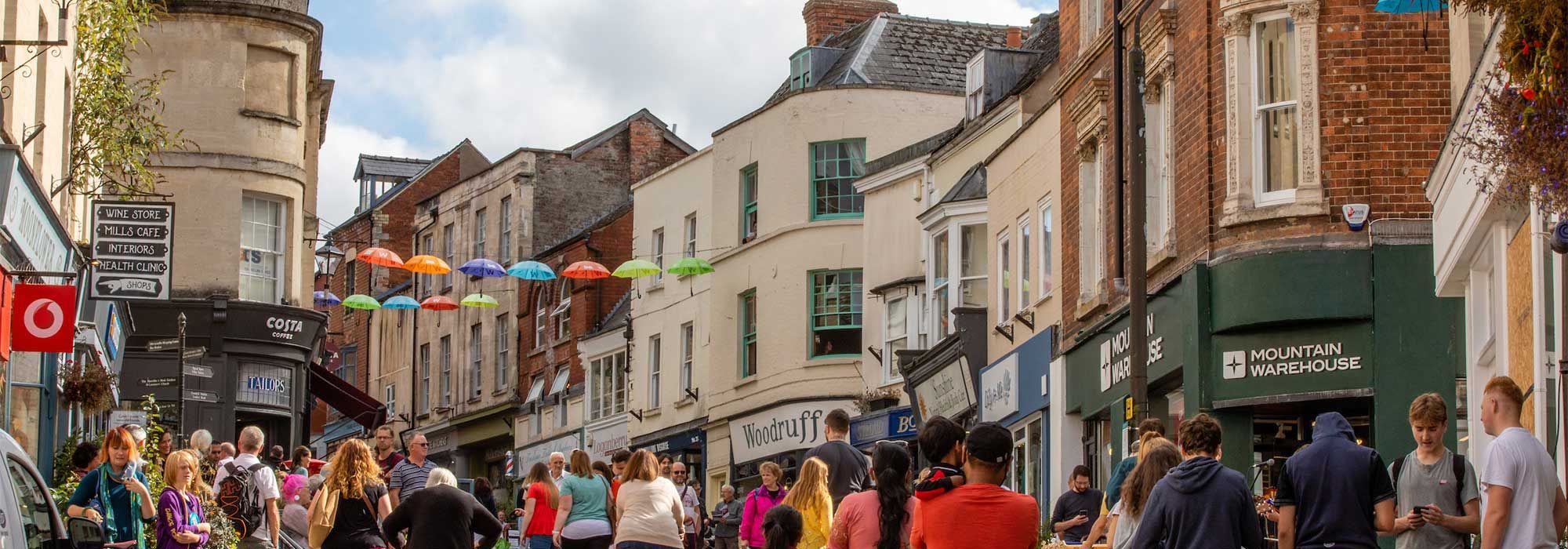
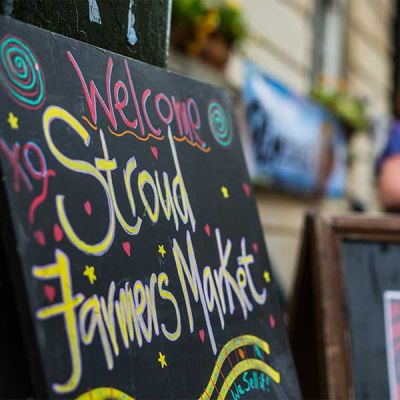
Stroud has been described as “Notting Hill with Wellies”—a creative, bohemian town with a character all its own. In 2021 it was named the best place to live in the UK by The Sunday Times, praised for its strong community spirit, thriving arts scene, independent businesses, rich textile heritage and beautiful surrounding countryside. The award-winning Stroud Farmers’ Market is a major draw, transforming the town centre each Saturday with around 50 stalls selling artisan food, local produce and crafts, accompanied by a lively, almost carnival-like atmosphere and frequent street music.
Read More
Stroud has long been known for its progressive politics and environmental leadership. It elected one of the UK’s first Green Party councillors in 1986 and became Europe’s first carbon-neutral local authority in 2015. The town is home to Ecotricity, the pioneering green energy company founded on a single Gloucestershire windmill, and it was also the birthplace of the Extinction Rebellion movement in 2018, which still has a local activist presence.
The town centre features a number of notable historic buildings. The Shambles, a narrow medieval lane lined with timber-framed buildings, hosts a small weekly market and contains the Old Town Hall, built in 1596 as a wool and cloth exchange. Nearby are the Medieval Hall, a restored 14th-century open-hall house, and St Laurence’s Church—now the Stroud Centre for Peace & the Arts—which has medieval origins but is largely Victorian due to later expansion funded by the wool trade. The Subscription Rooms, a grand Grade II Georgian building, remain a key venue for arts and events.
Just outside the centre stands Ebley Mill, once a major fulling and cloth mill on the River Frome and the Stroudwater Canal. Now home to Stroud District Council, it is considered one of the finest stone-built mills in the country, though its award-winning restoration in the late 1980s became controversial due to significant overspending. Visit Ebley Mill as part of our Selsley Common walk.
Painswick (16 miles)
The quintessential Cotswold wool town of Painswick, just four miles north of Stroud, is often called the “Queen of the Cotswolds” for its beautifully preserved medieval streets and honey-coloured stone houses built by wealthy clothiers. The town centre is a pleasure to wander through with its narrow lanes, hidden alleyways and historic inns such as the 17th-century Royal Oak or 15th-century Falcon Inn. For a boutique Cotswolds vibe, try The Painswick for a quiet drink on their lovely terrace.
Read More
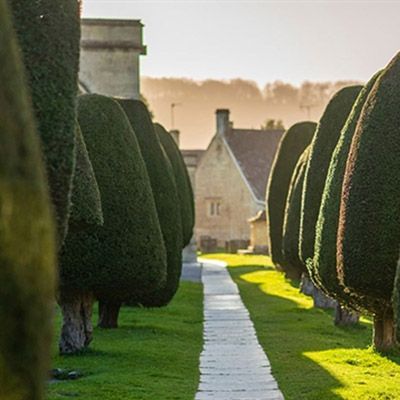
At its heart stands St Mary’s Church, one of the region’s finest wool churches, known for its elegant Georgian spire and iconic churchyard containing 99 clipped yews. According to local folklore, any attempt to plant a 100th tree is bound to fail because the Devil himself comes and pulls it up! The churchyard also features centuries-old tombs and Grade II-listed 19th-century “spectacle stocks” mounted on the boundary wall.
Other notable buildings include the Painswick Centre, originally a wool hall for storing and trading cloth, now a community arts venue, and the 16th-century Court House, a former manor and temporary royal lodging during the Civil War. The town has recently been featured in Conde Nast Traveller magazine as one of the 14 prettiest villages in the Cotswolds - we agree!
If travelling from Stroud, a short detour to the village of Slad is highly recommended. Set in a steep, wooded valley, it was the childhood home of writer Laurie Lee and the setting for his memoir Cider with Rosie. Visitors can pause at The Woolpack Inn—Lee’s favoured pub—and cross to Holy Trinity Church, where he is buried beneath a simple headstone poignantly inscribed “He lies in the valley he loved”. There is a stained-glass window in the church commemorating his life and work.
Bisley (16 miles)
Four miles south of Stroud, Bisley is a well-preserved example of a traditional Gloucestershire village, surrounded by farmland and woodland. Its name is thought to derive from Old English, meaning “wood clearing or meadow.” The village dates back to the medieval period and developed as part of the wool and cloth industry that shaped much of the surrounding area, with most residents working in farming or local trades connected to wool production.
Read More
The village centre retains many historic buildings, including 17th- and 18th-century houses built from local Cotswold stone. With its characterful graveyard, All Saints Church has a Norman font and medieval carvings, with extensions added in the 15th century during the height of the wool boom. Behind the graveyard on Wells Road is the Grade II-listed Seven Springs, built in 1863, which channels water through seven stone spouts fed by local springs. Each Ascension Day, villagers hold a traditional “Well-Dressing” ceremony at the springs.
Bisley has two pubs. The Bear Inn, in use since 1631, was originally the village courthouse and assembly room, and reportedly has a priest hole above the fireplace. Adjacent to it is the village prison, a two-cell lock-up built in 1824 for drunks and petty criminals awaiting the magistrate. The second pub, The Stirrup Cup, remains largely unchanged outwardly since the 18th century.
Bisley was home to the late Dame Jilly Cooper, whose racy and witty novels, most famously The Rutshire Chronicles, were inspired by the village, surrounding countryside, and local residents. In 2024, the second novel, Rivals, was adapted for Disney+, with many Tetbury locations providing the backdrop.
Despite its small size, Bisley has many amenities including a primary school, village hall, recreation facilities, Post Office, small shops, and numerous community events including an annual flower show and village fete. This strong sense of community maintains its status as a working rural settlement rather than a tourist-led centre. Highly recommended en route is the Bisley Farm Shop, north of the village on Bisley Road, which sells fresh local produce and plants, and has a friendly café serving freshly prepared lunches, snacks, and cakes.
Nailsworth (12 miles)
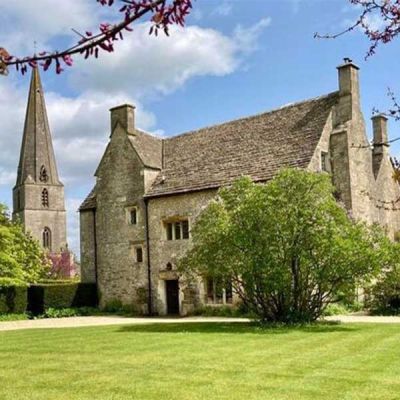
Nailsworth is a small Gloucestershire town in a narrow valley five miles south of Stroud. Its origins go back to the medieval period, with early growth driven by the fast-flowing streams that powered corn mills, fulling mills and later cloth production. By the 17th and 18th centuries, Nailsworth had become a key local centre for wool and milling, a history still visible in buildings such as Egypt Mill—a former 16th-century mill complex beside the River Frome, now a hotel and restaurant.
Read More
Although Nailsworth never received a formal market charter, it evolved into a commercial hub for surrounding villages. Its Georgian and Victorian high-street buildings reflect its transition from a mill settlement into a small service town. During the 20th century, the decline of traditional milling led many former industrial buildings to be adapted for light industry, offices and housing.
Today, Nailsworth is known for its concentration of specialist food shops, independent retailers and small galleries. It has gained a reputation as a mini foodie hotspot, home to several award-winning businesses including Hobbs House Bakery and Williams Food Hall and Fish Market, and it offers an excellent selection of cafes, pubs and restaurants.
As a mill town rather than a market town, Nailsworth has a more industrial character than nearby Minchinhampton and provides an interesting contrast to places like Wotton-under-Edge and Bisley. Its mills, stone houses and steep valley setting all reflect the industries and geography that shaped its development.
Minchinhampton (14 miles)
Four miles south of Stroud, Minchinhampton is a small market town with Saxon origins that grew into a local trading centre during the Middle Ages, driven by the wool and cloth industry. Its layout and architecture still reflect this past. In the centre stands the 17th-century Market House, once a base for cloth trading and local governance. Former weavers’ cottages—tall, narrow houses with enlarged upper windows for looms—and merchant houses survive around the High Street and Well Hill.
Read More
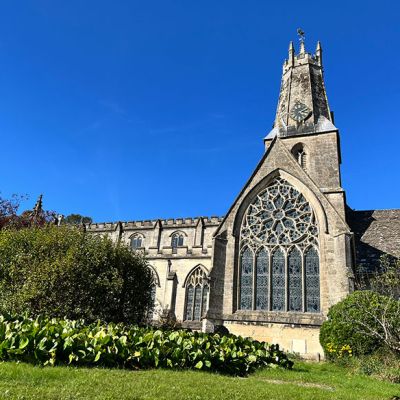
Close by is the Church of the Holy Trinity, largely rebuilt in the 19th century but retaining its striking 13th-century tower, visible from across Minchinhampton Common. The Common itself is a major feature of the town: a large expanse of open limestone grassland, still grazed under ancient rights and now managed by the National Trust. When driving, do watch out for free roaming cattle that regularly meander across the road!
After exploring the town or walking the Common, visitors can stop at one of two cafés or at the refurbished 18th-century Crown Inn. Like other Southern Cotswold settlements described here, Minchinhampton functions primarily as a working town and local centre rather than a tourist-led destination, while still offering considerable historic interest and character.
Tetbury (14 miles)
Tetbury is the second-largest town in the Cotswolds and, akin with other Cotswold settlements, has a history rooted in the medieval wool trade. The town retains much of its historic layout, with narrow streets, stone houses built by wealthy wool merchants, and traditional coaching inns. To the north of the town, Chipping Steps is a steep cobbled laneway lined with former weavers’ cottages, historically linking the lower town to the original market area.
Read More
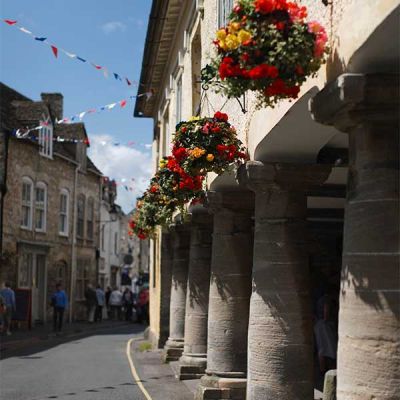
In the town centre, the Market House, built in 1655 on elegant stone piers, still hosts markets and community events. The originally medieval St Mary’s Church was rebuilt in the 18th century and features England’s fourth-tallest church spire and a churchyard rich with historic monuments.
Tetbury is also known for its royal connections. Highgrove House, King Charles III’s country home since 1980, is nearby, and its gardens, created by the King, are open to the public.
Today, Tetbury thrives as a centre for independent retail, with antiques shops, boutiques, art galleries, cafes, pubs, and restaurants. Visitors can easily spend a day exploring the historic streets, church, and Georgian-fronted Long Street, while enjoying some shopping or simply taking in the architecture.
Free parking is available north of town near Chipping Steps at the Tetbury Goods Shed, a restored Victorian railway goods building. Once part of the Great Western Railway branch line, it now serves as the town’s community arts centre, hosting music, theatre, film screenings, exhibitions, workshops, and a café.
Spa Towns
Cheltenham (23 miles)
Unlike its famous spa sister city Bath, Cheltenham was not a major Roman settlement and can be seen as something of a “late starter” in the popularity stakes. The nearby Roman Fosse Way and local archaeological finds suggest the area was once dotted with small farmsteads and villas. For centuries it remained a modest farming community, positioned between the fertile Severn Vale and the Cotswold escarpment.
Read More
By the 12th century, recorded in the Domesday Book, Cheltenham had grown into a thriving manor with a population engaged in farming, sheep grazing and local trade. Though not a major hub of the Cotswold wool trade, it benefitted from the wealth it generated, with Gloucester, just ten miles west, serving as a major export route via the River Severn.
Everything changed in 1716 when farmer William Mason noticed pigeons pecking at a local mineral spring and “looking rather healthy.” His family developed the spring for visitors and soon, in an age fascinated by spa bathing and “taking the waters,” people began arriving in search of cures. The turning point came in 1788 when King George III visited in hope of easing his illness. The royal visit, commemorated with souvenir mugs and prints, transformed Cheltenham overnight into a fashionable resort.
Cheltenham’s boom spanned the Georgian period (1714–1830) but it is the later Regency era (1811–1820) with which the town is most closely associated, earning it the title “Britain’s most complete Regency town.” While Georgian architecture stressed symmetry and restraint — red brick, sash windows and limited decoration — Regency design added sparkle: pastel stucco, iron balconies, tall windows and sweeping crescents set around gardens. Think of Georgian style as a smart business suit; Regency is the evening dress — same cut, but with more flair!
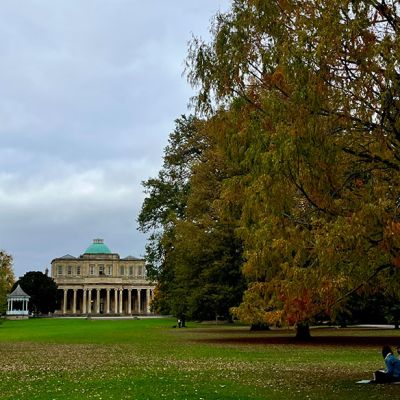
Today visitors can explore this Regency legacy on foot. To the north lies Pittville Park, the town’s largest ornamental park, with lakes and gardens leading to the grand Pittville Pump Room (1830), Cheltenham’s most celebrated Regency landmark. Nearby is Pittville Circus, a graceful tree-lined circle surrounded by Regency and Victorian villas.
Heading south towards the centre brings you to Royal Crescent (1806–10) and the wide Promenade (laid out in 1818), a tree-lined boulevard once designed for fashionable strolling and still Cheltenham’s shopping heart. At its southern end are the Imperial Gardens (1820s), with tree-lined walks and flowerbeds. On one corner stands the imposing Queen’s Hotel which was built in 1837, at the dawn of the Victorian era, its architecture is more solid and imposing than the light elegance of Regency design(1837). Inside, don’t miss the 175-year-old “Gothic Lily” wallpaper by Pugin, also used in the Palace of Westminster.
In the chic Montpellier District you’ll find stucco terraces and independent boutiques. Montpellier Walk is famous for its 32 stone caryatids (1840), modelled on the maidens of the Acropolis. Across the road, the domed Montpellier Rotunda (1825), now home to The Ivy Brasserie, is a spectacular spot for a drink beneath its ornate ceiling. Adjacent Montpellier Gardens (1817) remain a lively space for festivals and concerts.
While Cheltenham is world-renowned for its Regency architecture, it is equally famous today for its cultural life — from the Cheltenham Festival of Horse Racing to international festivals of literature, science and jazz. Just as 18th-century visitors came for health and society, today’s visitors flock here for culture, style and celebration, making Cheltenham truly the cultural capital of the Cotswolds.
Bath (34 miles)
Unlike Cheltenham, Bath’s fame began almost two millennia earlier. The Romans established Aquae Sulis in the 1st century AD around the only hot springs in Britain, creating a sophisticated bathing and temple complex dedicated to the goddess Sulis Minerva. The city flourished as a spa until the Romans’ withdrawal around 410 AD and then dwindled as a market town until the arrival of the wool trade. Bath acted as a centre for dyeing and finishing fine cloth woven in surrounding villages and, as it was in other Cotswold towns, wealth from this lucrative industry helped fund the rebuilding of Bath Abbey and laid the foundations for the city’s prosperity as the spa waters once again took centre stage.
Read More
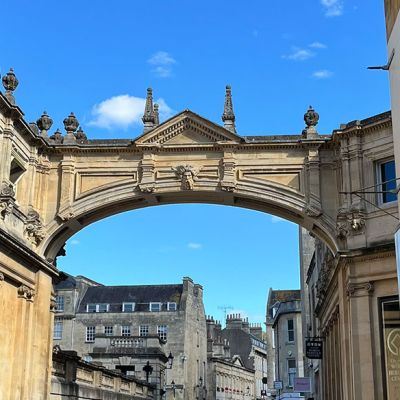
Bath’s reprisal as a fashionable spa began in the 17th century, attracting aristocrats, gentry, and eventually royalty, keen to “take the waters” and this boom continued into the Georgian period (1714–1830). Inspired by the Palladian ideals of classical harmony, proportion and symmetry that became fashionable throughout Britain in the early 18th century, architects such as John Wood the Elder and John Wood the Younger laid out sweeping terraces, crescents and squares that remain the city’s signature.
Georgian architecture in Bath is strikingly uniform, built almost entirely from locally quarried “Bath stone”, the same geological formation as the honey-coloured limestone of the Cotswold medieval villages but paler in colour. While there are a handful of examples of Regency buildings, Bath’s iconic crescents and squares were already complete before the Regency began and the overarching architectural style is grand, ordered and monumental. In 1987, this outstanding urban ensemble earned Bath UNESCO World Heritage status.
Visitors can step back in time at the Roman Baths, where steaming pools still bubble beside the medieval Bath Abbey. Just across the square is the 18th-century Pump Room, where Georgian society gathered to drink spa water, listen to music and be seen. One of the earliest Georgian developments was Queen Square (1728-1736) featuring uniform classical terraces around a central garden.
To the north lie Bath’s most famous architectural set-pieces: the Royal Crescent (1774), a sweeping arc of 30 terraced houses overlooking the Royal Victoria Park, and The Circus (1768), a perfect circle of townhouses with classical columns, designed to echo Rome’s Colosseum. Linking them is Brock Street, part of John Wood’s grand vision for a harmonious cityscape. Nearby, Pulteney Bridge (1774) spans the River Avon — one of only four bridges in the world lined with shops on both sides.
Bath is also a city of green spaces and cultural venues. The Assembly Rooms, once home to glittering Georgian balls and frequented by Jane Austen’s characters, now house a Fashion Museum. Austen herself lived in Bath from 1801 to 1806, and the city today celebrates her legacy with the Jane Austen Centre and annual festival.
Modern Bath remains a blend of past and present. The Thermae Bath Spa allows visitors to bathe in natural hot springs as the Romans once did, with rooftop pools offering stunning views of the city. Bath is also a hub of arts and culture, hosting festivals of literature, music and food, alongside vibrant shopping streets and lively cafés.
Why not explore Bath via our walk from Bradford-on-Avon — a relaxed way to arrive without the stress of city parking!